Don Hemphill
Needful ThingsDon Hemphill is a butcher and a deacon in Castle Rock whose role in Reverend William Rose’s anti-gambling campaign makes him a forceful participant in the town’s rising religious conflict. His confrontations with Father John Brigham, his commitment to Rose’s organizing, and his response to an attack on his market show how personal anger and material grievance become part of a wider breakdown in communal restraint.
Identity and Church Conflict
Don is one of Reverend William Rose’s deacons and is described as both taller and heavier than Father John Brigham. When Brigham confronts Rose outside the rectory, Don offers to take up the dispute himself, making clear that the exchange between clergy has the potential to become physical. Two deacons restrain him, preventing an immediate fight; the episode nevertheless marks a shift from the hostility that had largely remained in taunts, malicious talk, and verbal attacks between the churches.
The conflict had not emerged from nowhere. Before the events of October, tension between Castle Rock’s Catholic and Baptist communities had mostly surfaced as insults in church groups, children’s taunting, hostile remarks from pulpits, and occasional acts against church property. Don’s readiness to confront Brigham gives that accumulated antagonism a personal and threatening face. He is not merely an observer of the dispute: his standing among the deacons makes him one of the people capable of translating its language into action.
Role in the Anti-Gambling Campaign
Don is a promised attendee and a leading supporter of Rose, who regards him as his strong right arm. At the fourth meeting of the Baptist Anti-Gambling Christian Soldiers of Castle Rock, more than seventy people gather. Attendance had fallen at the previous meeting, but rumors about an obscene card sent to the parsonage renew interest. Rose is relieved by the turnout and disappointed that Don has not yet appeared, underscoring how much he depends on Don’s presence in the campaign.
The church dispute also intersects with the town’s argument over Casino Nite. Rose protests that the event is gambling for money, while Alan Pangborn explains that it is structured as a charitable donation exchanged for play money, with prizes rather than cash awarded at the end. That legal distinction does not resolve the moral disagreement. Don’s place among Rose’s supporters connects the campaign’s religious condemnation to the larger, increasingly volatile struggle over the event.
The Attack on His Market
Don eventually arrives during the meeting in his work clothes, still wearing his bloodstained butcher’s apron. He tells the congregation that his market has been stink-bombed and that its stock has been ruined. He estimates the loss at forty thousand dollars and says the store will continue to smell for days. The attack therefore brings the conflict into the meeting not as an abstract accusation but as a substantial injury to Don’s livelihood.
His account changes the gathering’s atmosphere: the congregation listens as he directs its attention to the damage and its financial scale. The grievance becomes a powerful new focus for the crowd’s anger. The incident does not establish Don’s place as a strategist behind the attack or identify him as responsible for it; what the scene shows is the way his loss is taken up within an already inflamed religious campaign.
From Congregation to March
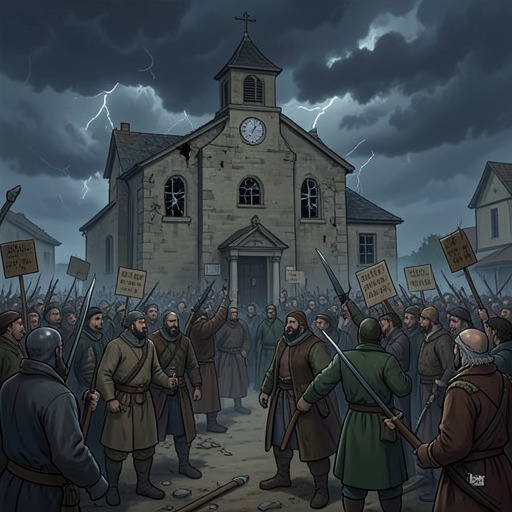
As the congregation leaves and a state trooper challenges its direction, Don begins singing “Onward, Christian soldiers, marching as to war.” Others join him, and the group moves from walking to marching. Rose sings with them as well. The hymn’s familiar language of religious devotion takes on a militant force in the moment: the congregation is no longer simply assembled to protest gambling but is moving together in anger toward confrontation.
Don’s actions trace a compact but consequential arc. At first, the other deacons have to restrain him from confronting Brigham; later, his anger at the destruction of his market helps focus the meeting; finally, his singing gives the departing crowd a shared rhythm and a martial expression. The narrative does not claim that his voice alone causes the march, but it places him at a decisive point in the group’s transition from grievance to collective movement. Through Don, the novel shows how religious language, economic loss, and existing prejudice can converge in a public crisis.